Stephen King adaptations seem to be more popular than ever this year; so far, we have seen Oz Perkins’ retelling of gory short story The Monkey, Mike Flanagan’s rumination on what it means to be human in Life of Chuck, and soon, Edgar Wright’s remake of The Running Man will be sprinting onto our screens. But all of these will struggle to eclipse to Francis Lawrence’s masterful endurance test, The Long Walk. Featuring a stellar cast of young men who willingly participate in a televised competition where only one can win fortune and a single wish. Lawrence’s newest release will no doubt draw comparisons to his previous success The Hunger Games. But The Long Walk acts as a mature successor to its teenage counterpart, still striking chords of relevancy that will no doubt chime in audiences minds’.
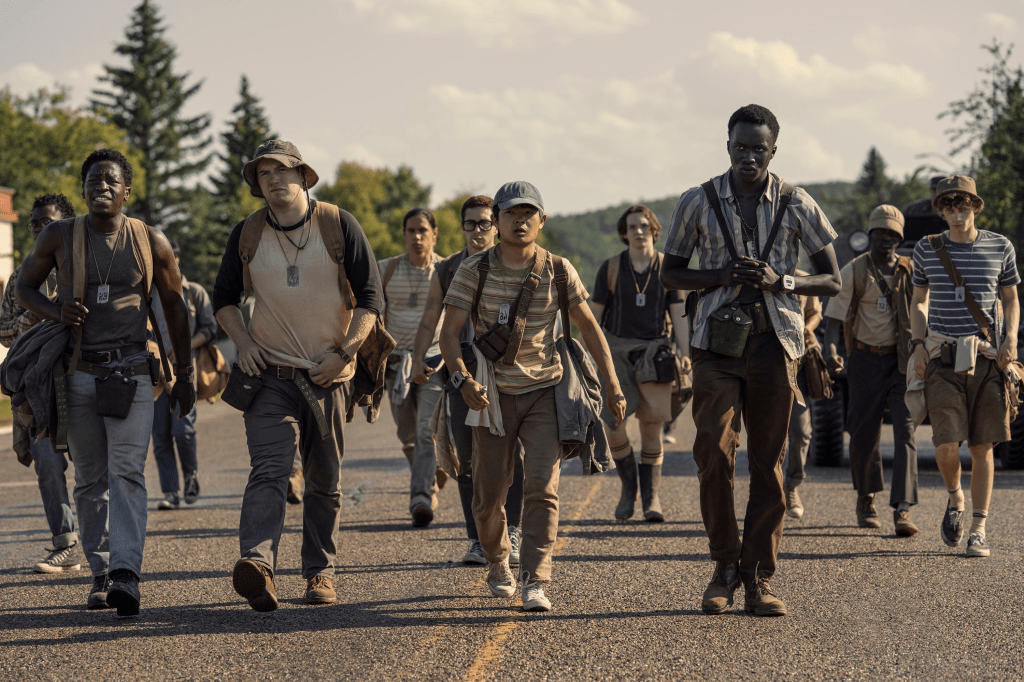
With any dystopian-style movie, such as this one, there is the tendency to stray from the point at hand; often, the message becomes entangled in a web of teenage love triangles and the subsequent drama that ensues. But The Long Walk is laser-focused on what it wants to say, wasting no time in the walk-at-hand getting started, and never really straying off course. Like in its namesake novel, we follow Ray Garraty (Cooper Hoffman), as he joins the long walk, leaving behind his mother for a chance at fame and fortune (although his reasoning is actually far from that). He is joined by a strong supporting cast; scar-adorned but unwaveringly charismatic Peter McVries (David Jonsson); sarcastically inclined and foul mouthed Hank Olson (Ben Wang); the athletic one-to-beat, Stebbins (Garrett Wareing); kind-natured, God-fearing Arthur Baker (Tut Nyuot); and psychotic antagonist loner Gary Barkovitch (Charlie Plummer). Each walker is a fully fleshed being, and none get lost or stampeded in what could have become an overcrowded riot in the hands of a less skilled director and screenwriter (J.T. Mollner, taking King’s story from page to screen). The cast undoubtedly know the material well, but what candidly shines through is the stunningly emotional bonds between each of them, particularly that of Garraty and McVries. Cooper Hoffman has unquestionably inherited his fathers talent, and David Jonsson continues to prove himself as a true star – his performance is layered, beautiful, and heart-wrenching. Acting as a foil to the boys is Mark Hamill’s The Major – Hamill clearly having fun as a somewhat over-the-top villain that would feel comical if the film was not so violently bleak.
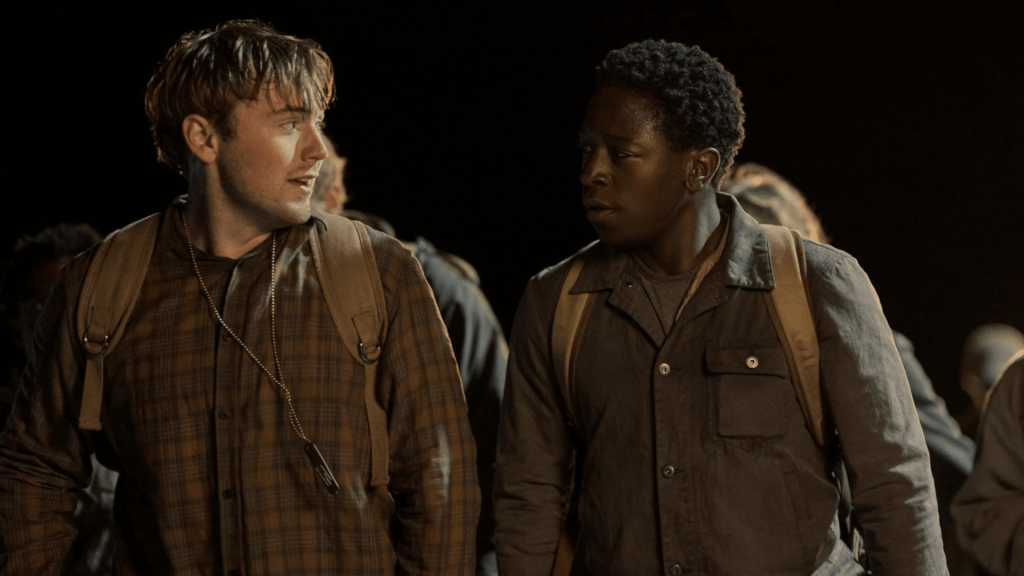
Dealing with our own mortality is one of the most perplexing experiences a human undergoes. We all know we are going to die – it is the only inevitability in life. But how do we comprehend our impending doom, and how far would we be willing to go to survive? These are questions that are arguably unanswerable, but The Long Walk manages to at least delve into the psyche’s of its characters to discover how it feels to lose all hope. Lives lost at the expense of entertainment is not a new idea, but here it is so brutally executed that it does not even feel entertaining; only hopeless. Whereas fans beg for more Hunger Games films set in the arena’s (missing the point of the novels themselves), The Long Walk requires no prequel or sequel; it does not create suffering into spectacle. Up-close scenes of boys receiving their ‘ticket’ at the end of a Carbine are not violent throwaways to create action packed thrills in the cinema; rather, each gunshot shudders through you like a freight train.
Final Verdict:
The Long Walk is relentless. It’s a brutal wasteland of dystopian America that provides a cinematic endurance test like no other this year. A bleak exploration of totalitarianism where winning is merely an illusion, The Long Walk is a devastating journey from beginning to end. Like a blend of Stand By Me and The Running Man, there is no doubt that this is a Stephen King story through and through – and proves to be one of his greatest adaptations yet.

 The Scream Queen
Leave a comment